
Power over Fiber: Wi-Fi Where Power Can't Easily Go
How a PoF power splitter and composite cable feed PON access points with data and DC power on one cable, and how it compares with traditional PoE.
Every Wi-Fi access point needs two things at the ceiling: a data link and power. With traditional Power over Ethernet (PoE), both come over one twisted-pair cable from a switch. That works well, up to the 100 m channel that PoE is built around.[4] In hotels, campuses and long corridors, that limit decides where the switches, closets and electrical work must go.
Power over Fiber (PoF) takes a different approach. Data rides on fiber, and the power for the device arrives with it. This guide explains the two quite different technologies sold as "PoF", shows a reference design built on UGRID's PoF products, and is honest about where PoE is still the better tool.
Two technologies share the name "Power over Fiber"
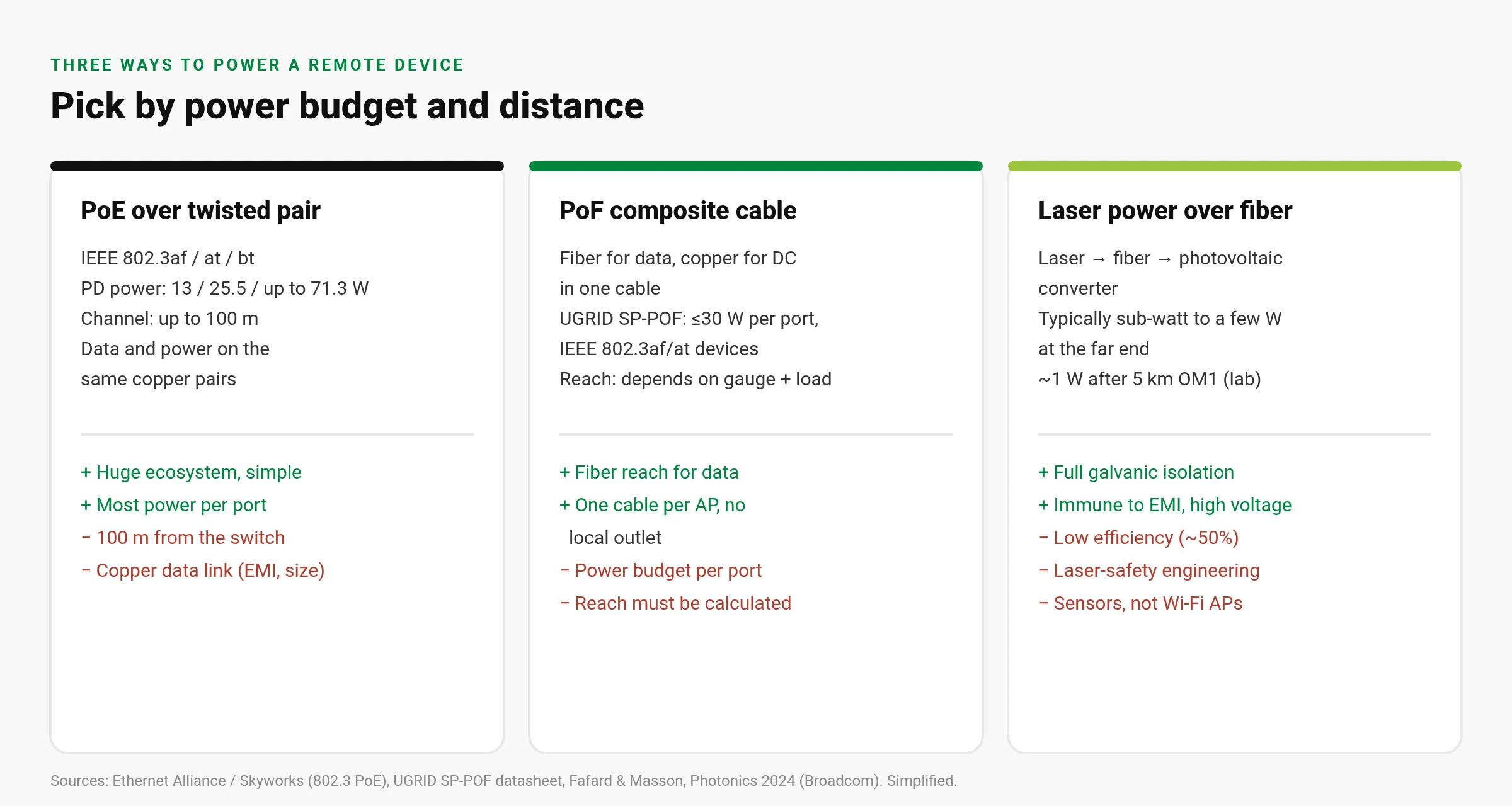
1. Optical-electric composite cable. One cable holds optical fiber for data and copper conductors for DC power. The fiber gives the data link its reach; the copper carries the power. This is what UGRID's SP-POF splitter and uAP PoF access point use. The SP-POF datasheet describes "remote power supply over optoelectronic composite cables — one cable to each terminal."[1] CommScope's Powered Fiber system is another example of the hybrid copper-and-fiber approach.[6]
2. Laser (optical) power over fiber. A high-power laser sends light down the fiber, and a photovoltaic converter at the far end turns it back into electricity. There is no metal in the link at all, which gives full galvanic isolation and immunity to electromagnetic interference. Broadcom's AFBR-POC306A1 converter, for example, delivers up to 3 W electrical at more than 50% conversion efficiency.[8] In published lab results, about 1 W was delivered after 5 km of multimode fiber, from about 2.5 W of optical input.[7] That suits sensors and isolated electronics. It is not enough for a Wi-Fi 6 access point, and light-based power needs laser-safety engineering under IEC 60825-2.[9]
For Wi-Fi coverage, the composite-cable approach is the practical one. The rest of this article focuses on it.
The reference architecture
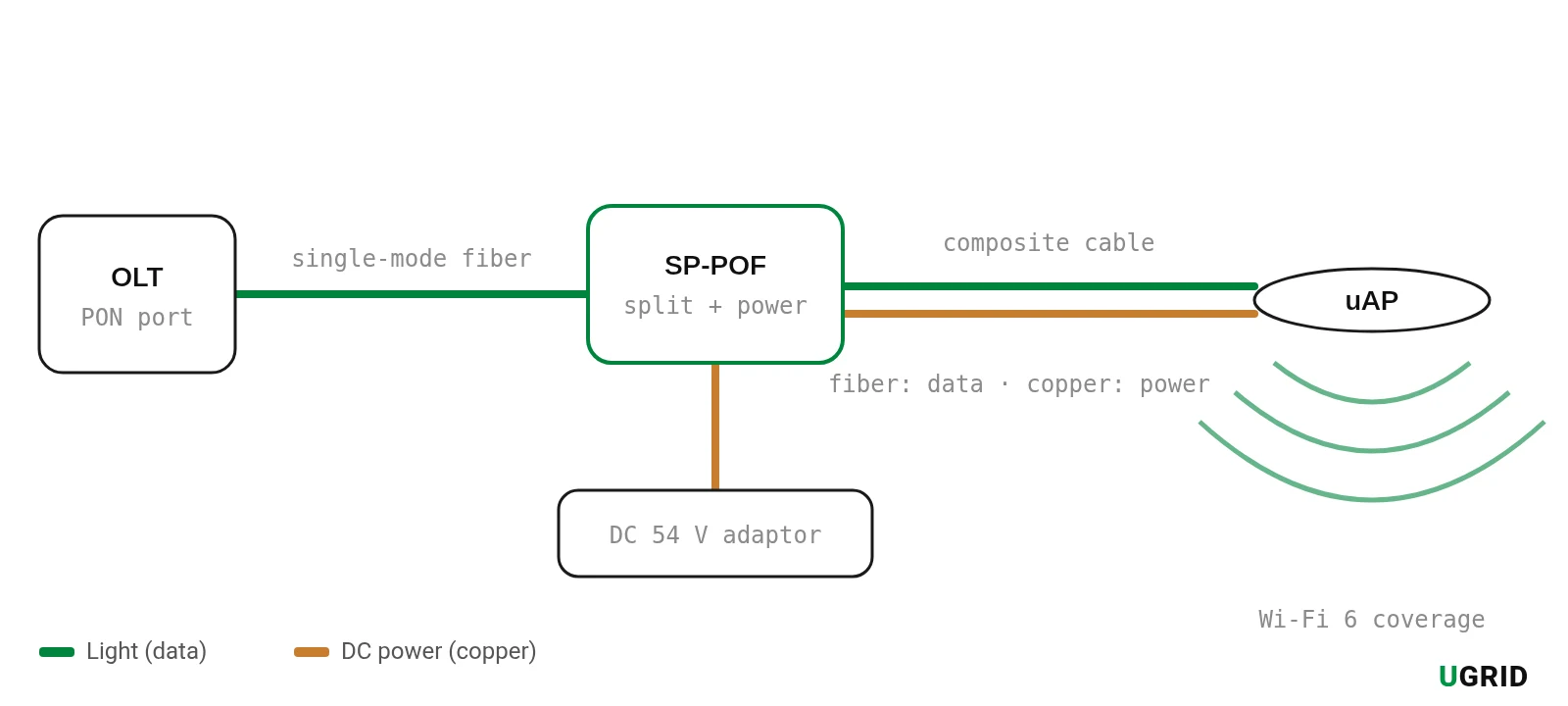
The design keeps the PON passive between the OLT and each floor. On each floor, an SP-POF power splitter does two jobs: it splits the optical signal, and it injects DC power onto each composite cable from its own 54 V adaptor.[1] Each uAP access point then receives data and power on one cable.
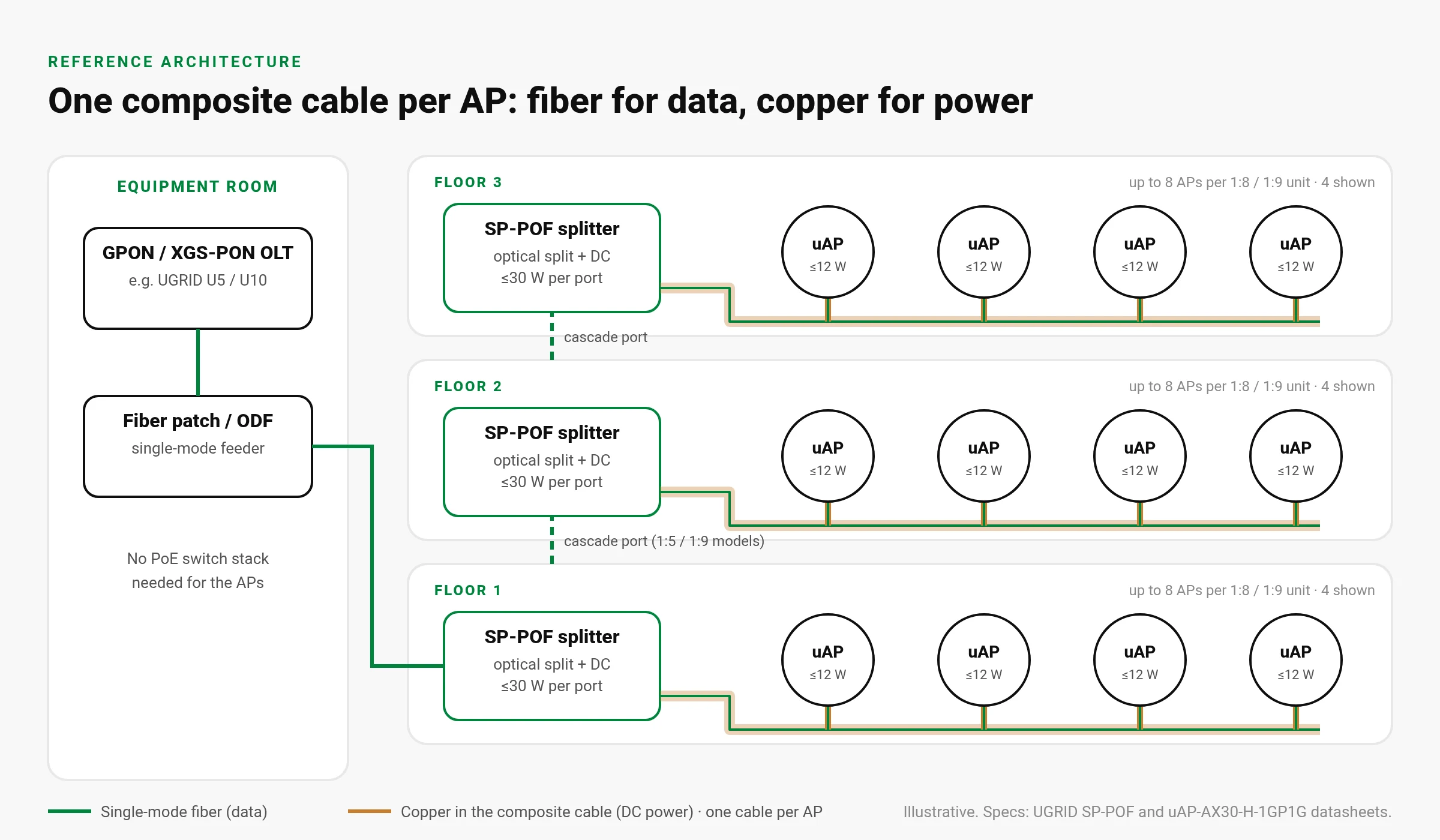
The two building blocks
| Item | SP-POF PoF power splitter | uAP-AX30-H-1GP1G PoF access point |
|---|---|---|
| Role | Optical split + remote DC power over composite cable | Ceiling AP with built-in XPON ONT and Wi-Fi 6 |
| Models / ports | 1:4 (4 outputs), 1:5 (cascade + 4), 1:8 (8 outputs), 1:9 (cascade + 8) | 1× XPON (GPON Class B+ / EPON PX20+), 1× GE RJ45 |
| Power | Max 30 W per port; ≤60 W total (4-port), ≤130 W total (8-port); IEEE 802.3af/at | PoF supply DC 48–56 V (or local DC 12 V / AC 100–240 V); consumption ≤12 W |
| Optics | 1260–1650 nm; SC/UPC or SC/APC; return loss ≥50 dB | TX 1310 / RX 1490 nm; RX sensitivity −27 dBm; 20 km PON reach |
| Wi-Fi | — | AX3000: 2402 Mbps (5 GHz) + 574 Mbps (2.4 GHz); up to 128 clients; mesh |
| Environment | −20 to +45 °C; desktop or wall mount | −10 to +50 °C; indoor ceiling mount |
Sources: UGRID datasheets.[1][2] Product pages: SP-POF PoF Power Splitter · uAP Indoor XPON PoF Mesh Router.
See it work
PoF vs traditional PoE: the honest comparison
| Factor | PoE over twisted pair | PoF composite cable (SP-POF + uAP) |
|---|---|---|
| Power to the device | 802.3af 13 W, 802.3at 25.5 W, 802.3bt up to 71.3 W at the device[3] | Up to 30 W per port; 802.3af/at class devices[1] |
| Data reach | 100 m channel from the switch[4] | PON fiber; the uAP optic is rated for 20 km[2] |
| Power reach | Same 100 m channel; part of the power is lost in the cable[4] | Set by conductor gauge, voltage and load. Not stated in the UGRID datasheets; calculate per project |
| Active gear on the floor | PoE switch per closet within 100 m of every AP | Passive optical split plus a DC adaptor per splitter |
| Headroom for new APs | 802.3bt can power high-end Wi-Fi 7 APs[5] | 30 W per port: fine for a ≤12 W Wi-Fi 6 AP, short of 802.3bt-class APs |
| Ecosystem | Universal: any PoE AP, camera or phone | Needs PoF-capable endpoints such as the uAP, or a PoF ONU |
Where PoF composite wins
- Distance. Data travels on fiber, so APs are no longer tied to a switch within 100 m.
- One cable per AP. No separate power outlet at the ceiling and no second cable.[1]
- Fewer active closets. The split is passive; the only power on the floor is the splitter's adaptor.
- Built-in protection. The SP-POF has voltage and current protection.[1]
Where PoE is still the better choice
- High-power APs. Some Wi-Fi 7 APs need 802.3bt for full function. The Arista C-460, for example, draws up to 41.8 W, and on 802.3at it disables a LAN port and USB and reduces 2.4 GHz to 2x2.[5] A 30 W PoF port cannot power such an AP fully.
- Mixed devices. Cameras, phones and third-party APs plug straight into PoE. PoF needs compatible endpoints.
- Short runs. If every AP is within 100 m of a closet that already has a PoE switch, PoE is simpler.
- Power reach must be engineered. Copper still has resistance. Each long run needs a voltage-drop check against the cable's conductor size.
Example scenario: hotel Wi-Fi on PoF
This is an illustrative design, not a customer project. All device figures come from the UGRID datasheets; fiber and connector losses must be measured on site.
A four-floor hotel wing needs 32 ceiling APs, eight per floor, in corridors and meeting rooms. The rooms are far from the telecom closet, and the owner doesn't want a PoE switch on every floor.
Design. One GPON port feeds a single fiber up the riser. Floors 1–3 use the 1:9 model (SP-POF-1-1-8): eight powered outputs plus a cascade port to the next floor. Floor 4, the end of the chain, uses the 1:8 model (SP-POF-1-0-8), which has no cascade port.[1]
Power check (per floor).
- Each uAP consumes ≤12 W, well under the 30 W port maximum.[1][2]
- 8 APs × 12 W = 96 W, within the 8-port model's ≤130 W supply.[1] That leaves 34 W of headroom per splitter.
Optical check (worst case). Using the datasheet's maximum insertion losses (cascade port ≤2.3 dB; 1:9 output ≤16.5 dB; 1:8 output ≤10.9 dB):[1]
| Floor | Splitter loss to an AP | Left within GPON Class B+ (28 dB) |
|---|---|---|
| 1 | 16.5 dB | 11.5 dB |
| 2 | 2.3 + 16.5 = 18.8 dB | 9.2 dB |
| 3 | 2.3 + 2.3 + 16.5 = 21.1 dB | 6.9 dB |
| 4 | 2.3 × 3 + 10.9 = 17.8 dB | 10.2 dB |
GPON Class B+ allows 13–28 dB of path loss.[10] The tightest floor (3) leaves 6.9 dB for the feeder fiber, connectors and splices. In a single building, that is usually comfortable, but measure it. The result: 32 APs on one PON port, one composite cable to each AP, and no PoE switches on the floors.
Secondary scenario: a remote or mountain site
Illustrative, with a caution. In a remote village or mountain lodge, a cable run of around a kilometre is a common question. Three facts set the limits:
- Data is not the constraint. The uAP's PON optic is rated for 20 km.[2]
- Power is the constraint. Neither UGRID datasheet states a maximum composite-cable length. For scale, CommScope rates its own powered-fiber system at 30 W per 12 AWG pair to 1,800 m and 60 W to 880 m.[6] These figures belong to that system and depend on its cable and power supply; any UGRID run should be calculated from the actual cable specification.
- The equipment is indoor-rated. The uAP works from −10 to +50 °C and the SP-POF from −20 to +45 °C.[1][2] Both belong inside a building, not on a pole.
Wi-Fi also doesn't restore mobile signal by itself. Phones get calls over Wi-Fi only where the carrier supports Wi-Fi calling; carrier coverage needs operator equipment. A practical remote design runs fiber to a building, then uses PoF inside it to reach APs that have no nearby power outlet.
Safety and installation notes
- Composite cable. Treat it as both a fiber and a DC power cable: follow local electrical code for routing and separation, and keep fiber bend limits.
- Laser PoF is different. Light-based power systems must be assessed for hazard levels at each accessible point of the fiber system under IEC 60825-2. A fiber break is a typical exposure event, and automatic power reduction (APR) is the usual safeguard.[9]
- Connectors. Order APC or UPC to match the rest of your ODN; the SP-POF is offered with both.[1]
FAQ
Is Power over Fiber the same as PoE?
No. PoE carries data and power on the same copper pairs, up to 100 m. PoF composite cable carries data on fiber and power on separate copper conductors in the same cable. Laser PoF carries power as light.
How much power can the SP-POF deliver?
Up to 30 W per port, with a total of ≤60 W on 4-output models and ≤130 W on 8-output models, for IEEE 802.3af/at class devices.
Can PoF reach 1,000 m?
The data can: the uAP's PON optic is rated for 20 km. The power reach depends on the composite cable's conductor size, the voltage and the load. The UGRID datasheets do not state a maximum, so calculate it for each project.
Can PoF power a Wi-Fi 7 access point?
Only if the AP's needs fit within 30 W. Some Wi-Fi 7 APs need 802.3bt power for full function, and PoE is the better fit for them.
Plan a PoF Wi-Fi deployment
Tell us your floor plan, AP count and cable runs. We'll check the power and optical budgets with you and size the SP-POF splitters and uAP access points.
Talk to our teamReferences
- UGRID Network Inc., SP-POF Series PoF Power Splitter, product datasheet (SP-POF-R02) [PLACEHOLDER: public datasheet/product URL]. link pending
- UGRID Network Inc., uAP-AX30-H-1GP1G uAP Indoor XPON PoF Mesh Router, product datasheet (R02) [PLACEHOLDER: public datasheet/product URL]. link pending
- Ethernet Alliance, “Overview of 802.3bt – Power over Ethernet standard” (v2.1, 2019). https://ethernetalliance.org/wp-content/uploads/2019/12/WP_EA_Overview8023bt_V2p1_FINAL.pdf
- Skyworks Solutions, “Understanding the IEEE 802.3bt PoE Standard” (white paper). https://www.skyworksinc.com/-/media/SkyWorks/SL/documents/public/white-papers/understanding-the-ieee-8023bt-poe-standard.pdf
- Arista Networks, C-460 Wi-Fi 7 Access Point datasheet. https://www.arista.com/assets/data/pdf/Datasheets/Arista-C-460-Datasheet.pdf
- CommScope, Powered Fiber Cable System brochure (SYSTIMAX FiberREACH). https://webresources.commscope.com/download/assets/Brochure:+Powered+Fiber+Cable+System/3b49156a3bd311f0ac24068e18034550
- S. Fafard and D. P. Masson, “Power-over-Fiber at 5 km”, Photonics 2024, 11(7), 596. https://www.mdpi.com/2304-6732/11/7/596
- Broadcom, AFBR-POC306A1 optical power converter, product page. https://www.broadcom.com/products/fiber-optic-modules-components/industrial/optical-power-components/optical-power-converters/afbr-poc306a1
- IEC 60825-2:2021, Safety of laser products – Part 2: Safety of optical fibre communication systems (OFCS). https://webstore.iec.ch/en/publication/29858
- ITU-T Recommendation G.984.2, Gigabit-capable passive optical networks (G-PON): Physical media dependent (PMD) layer specification. https://www.itu.int/rec/T-REC-G.984.2