Migrating to DOCSIS 3.1: What 1.2 GHz Means for Your Outside Plant
Why the 1.2 GHz upgrade matters — and why grounding, shielding and RFI control decide whether it delivers.
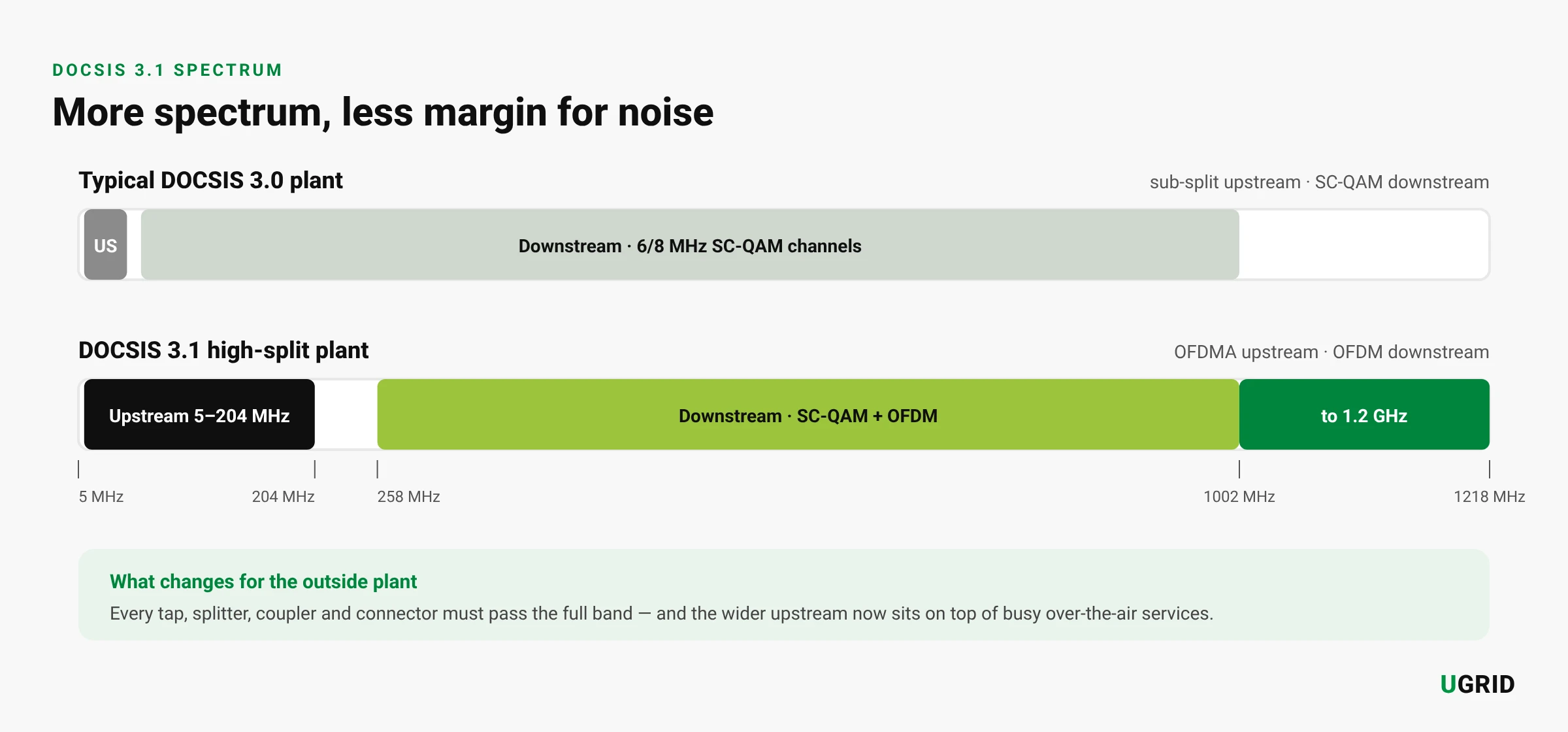
DOCSIS 3.1 lets cable operators push far more capacity through the hybrid fiber-coax (HFC) plant they already own. It does that with two big changes: OFDM/OFDMA modulation with higher-order QAM, and more spectrum — downstream up to about 1.2 GHz (1218 MHz) and, with a mid- or high-split, an upstream that can reach 85 or 204 MHz.[1]
The headend and the modems get most of the attention. But every one of those extra megahertz has to travel through the outside plant: amplifiers, taps, splitters, directional couplers, connectors and drop cable. And the more spectrum and the denser the modulation, the less tolerance the plant has for one old enemy — RF interference that leaks in through poor grounding, loose fittings and broken shielding.
What actually changes with DOCSIS 3.1
- OFDM downstream, OFDMA upstream: instead of a few 6 or 8 MHz single-carrier QAM channels, data rides on wide blocks of many narrow subcarriers. Profiles can run high-order QAM (4096-QAM downstream, with even higher orders defined in the spec) where the signal is clean.[1]
- Extended downstream to 1.2 GHz: many legacy plants were built and swept to 750 MHz, 862 MHz or 1 GHz. Running OFDM above that needs actives and passives that pass the band cleanly.
- Bigger upstream: moving from a sub-split (about 5–42 MHz in North America)[1] to mid-split (5–85 MHz) or high-split (5–204 MHz) multiplies upstream capacity — and moves the diplex filters in every active.
- Backward compatibility: DOCSIS 3.1 coexists with legacy SC-QAM channels, so the migration can be staged node by node.[1]
What 1.2 GHz means for passives
Passives are easy to forget because they have no power supply and no firmware. But a tap or splitter specified to 1 GHz has no guarantee of performance above it: insertion loss, return loss, port-to-port isolation and flatness can all degrade out of band. When you extend the downstream, every passive in the cascade either passes 1.2 GHz well or quietly eats into your OFDM signal quality.
- Insertion loss and tilt rise with frequency, so the plant must be re-balanced and re-designed for the new upper edge — not just the old one.
- Return loss (impedance match) matters more: reflections between poorly matched devices create micro-reflections and ripple that OFDM receivers must equalize away.
- Isolation and shielding effectiveness determine how much signal escapes (egress) and how much outside RF gets in (ingress).
- Upstream passband: with high-split, passives must also pass the upstream cleanly up to 204 MHz.
As general guidance, if a cascade is being opened up for node splits or amplifier upgrades, it is usually the right moment to swap in 1.2 GHz-rated passives rather than revisit the same poles later.
Why grounding and RFI matter more at 1.2 GHz
Coax works because its shield is continuous and bonded. Every break in that shield — a loose F-connector, a corroded fitting, a cracked jumper, an unterminated tap port, a housing that isn't properly bonded — turns the plant into an antenna in both directions:
- Ingress: over-the-air signals (broadcast, two-way radio, amateur and LTE/5G services, impulse noise from electrical equipment) enter the plant. Noise funneled from many homes accumulates in the upstream at the node.
- Egress (leakage): cable signals escape. Besides degrading your own signal, leakage in bands shared with aeronautical and other licensed services is regulated, and operators are expected to find and fix it.[3][4][5] Leakage and ingress usually share the same physical cause.
DOCSIS 3.1 raises the stakes. Higher-order QAM needs a cleaner signal (higher MER) to hold its profile; when noise rises, modems fall back to a more robust, lower-capacity profile, and the extra capacity you paid for disappears. The expanded upstream also overlaps more over-the-air services than the old 5–42 MHz band did, and the new downstream spectrum shares frequencies with LTE/5G mobile, so a shielding defect that was tolerable on a legacy plant can become a real impairment.
Grounding is a safety and a signal issue
Proper bonding of the strand, active and passive housings and the subscriber drop to the electrical ground (following your local electrical code and your company's construction practices[6]) protects people and equipment from lightning and power faults. It also keeps the shield at a stable reference, which is part of what makes it an effective barrier against interference. Surge protection in the passives themselves adds another layer, but it does not replace a good bond.
| Plant defect | What it causes | Fix |
|---|---|---|
| Loose or finger-tight fitting | Ingress, egress, intermittent signal | Seat and torque to spec |
| Poor or missing bond | Shield not at a stable reference; safety risk | Bond housings and strand per practice |
| Open tap port | Ingress path, reflections | 75 Ω terminator on every unused port |
| Corroded or water-damaged fitting | Rising loss, shield breaks over time | Replace; weather-seal |
| Passive rated below 1.2 GHz | Loss, poor match and isolation above its band | Replace with 1.2 GHz-rated passive |
A practical migration plan
- Audit the plant. Know which nodes, amplifiers and passives are rated to what frequency, and where your leakage and upstream-noise trouble spots are today.
- Pick your split. Mid-split or high-split, and the downstream upper edge, drive which actives and passives must change.
- Upgrade passives with the actives. When a cascade is opened, replace taps, splitters and couplers with 1.2 GHz-rated units instead of leaving a 1 GHz bottleneck behind.
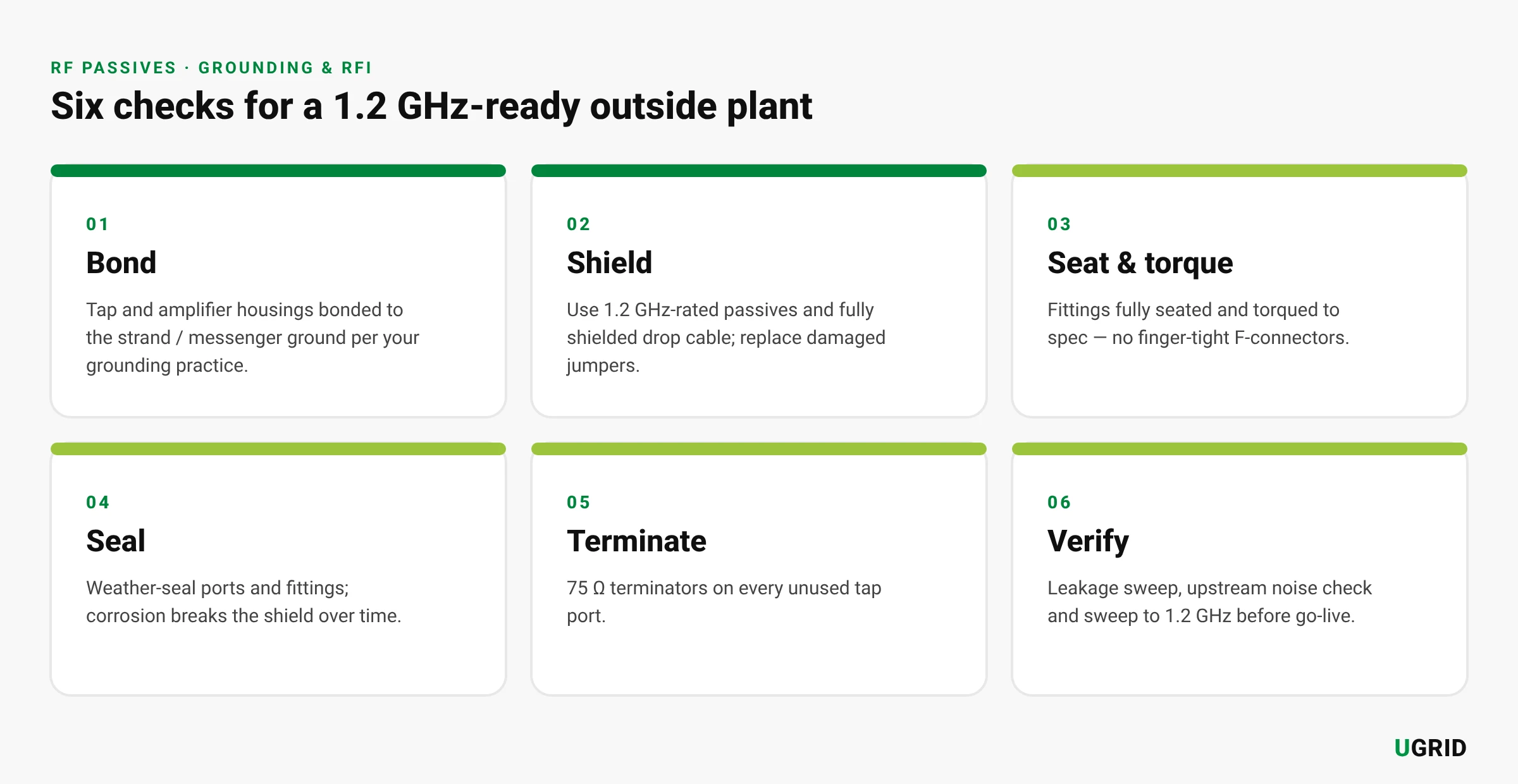
- Ground and harden as you go. Bond, torque, seal and terminate at every touch point — it's cheaper than a return visit.
- Verify before you turn on OFDM. Sweep to the new upper edge, run a leakage survey and check the upstream noise floor; then use proactive network maintenance (PNM) data from DOCSIS 3.1 modems to find what you missed.[2]
Bottom line
DOCSIS 3.1 turns existing coax into a multi-gigabit network — but only if the outside plant can carry 1.2 GHz cleanly. The upgrade isn't just new nodes and modems; it is every tap, splitter and fitting along the way, properly grounded, shielded and sealed. Get that right, and OFDM can run the high-capacity profiles you planned for.
DOCSIS 3.1-ready 1.2 GHz taps, splitters & couplers
UGRID outdoor taps, splitters and couplers are DOCSIS 3.1-ready 1.2 GHz passives, IP68 rated with 6 kV surge protection.
Shop at ugrid.onlineReferences
- CableLabs, “Cable Broadband Technology Gigabit Evolution” (Fall 2016), Appendix A: DOCSIS 3.1 Technology Highlights. https://www.cablelabs.com/wp-content/uploads/2016/09/Cable_Broadband_Technology_Gigabit_Evolution-Fall-2016-CableLabs.pdf
- CableLabs, “Primer for PNM Best Practices in HFC Networks (DOCSIS® 3.1),” CM-GL-PNM-3.1-V02-210114 (2021). https://account.cablelabs.com/server/alfresco/c021877d-cce7-434a-b3ac-9cc466d6c601
- U.S. eCFR, 47 CFR § 76.611 — Cable television basic signal leakage performance criteria. https://www.ecfr.gov/current/title-47/chapter-I/subchapter-C/part-76/subpart-K/section-76.611
- U.S. eCFR, 47 CFR § 76.613 — Interference from a multichannel video programming distributor (MVPD). https://www.ecfr.gov/current/title-47/chapter-I/subchapter-C/part-76/subpart-K/section-76.613
- U.S. eCFR, 47 CFR § 76.614 — Cable television system regular monitoring. https://www.ecfr.gov/current/title-47/chapter-I/subchapter-C/part-76/subpart-K/section-76.614
- NFPA 70, National Electrical Code® (Article 820 covers community antenna television and radio distribution systems). https://www.nfpa.org/codes-and-standards/nfpa-70-standard-development/70