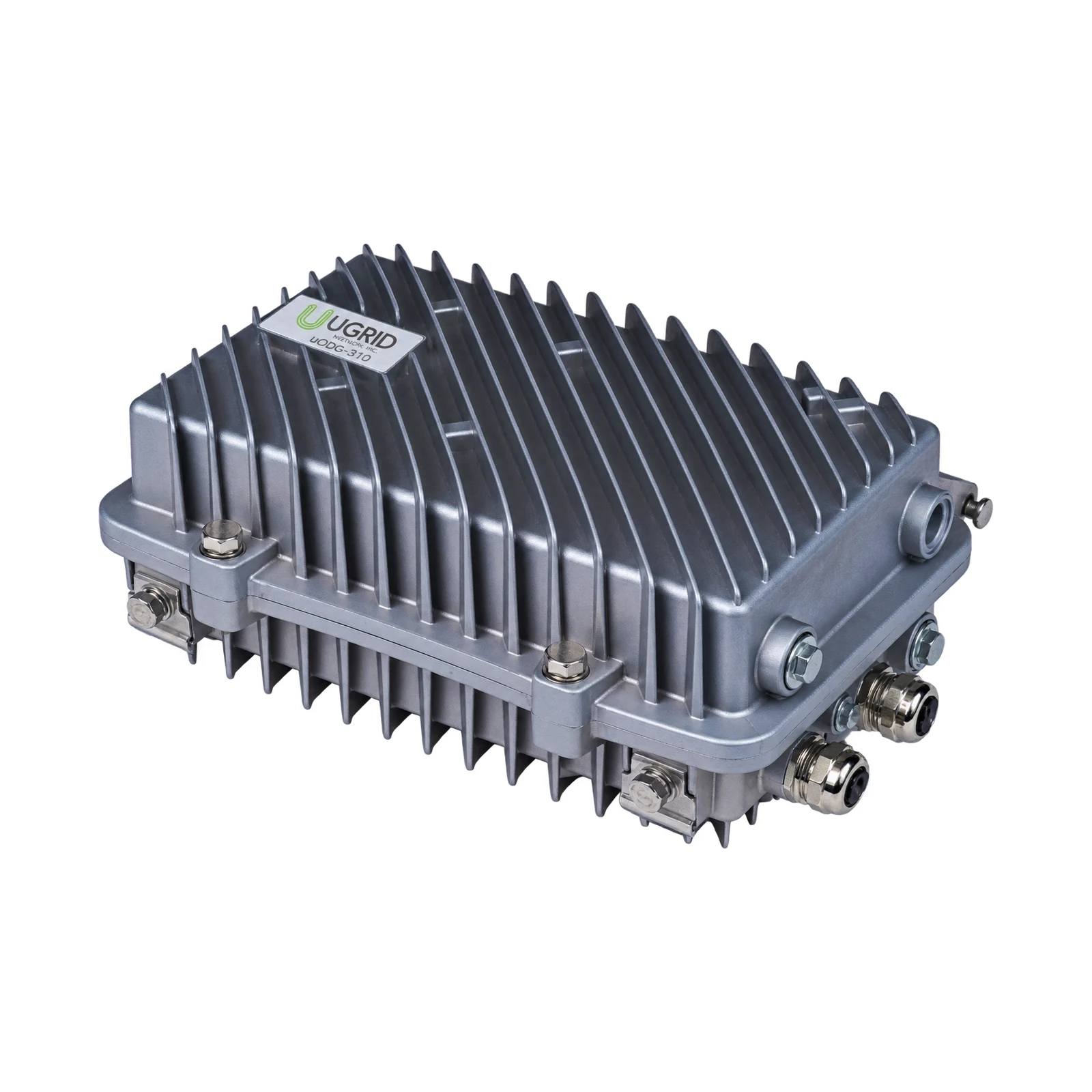
The uODG310 is an outdoor DOCSIS 3.1 gateway — a temperature-hardened, IP67-sealed cable gateway that takes broadband from the HFC plant and powers small cells and IP cameras over four PoE ports.
2 OFDM and 32 SC-QAM downstream channels and 2 OFDMA and 8 SC-QAM upstream channels, with an 85/108 or 204/258 MHz diplex split.
A full-band capture front end across the 1.2 GHz range, with an integrated real-time spectrum analyzer for plant visibility.
4× GE IEEE 802.3af/at ports: 30 W on two ports and 15.4 W on two, 75 W in total — each port configured separately, with remote PoE Mode A/B selection.
Draws 60/90 VAC line power from the HFC cable (40–120 VAC wide-range input), or runs from 110–220 VAC mains with the AC power supply option.
Monitors system power, temperature and RF power level, plus per-port PoE voltage, current, class and detection — and a tamper switch on the housing.
IP67 dust- and water-resistant housing that operates from −40 °C to +60 °C, with 6 kV surge protection per IEEE C62.41 for exposed outside-plant sites.
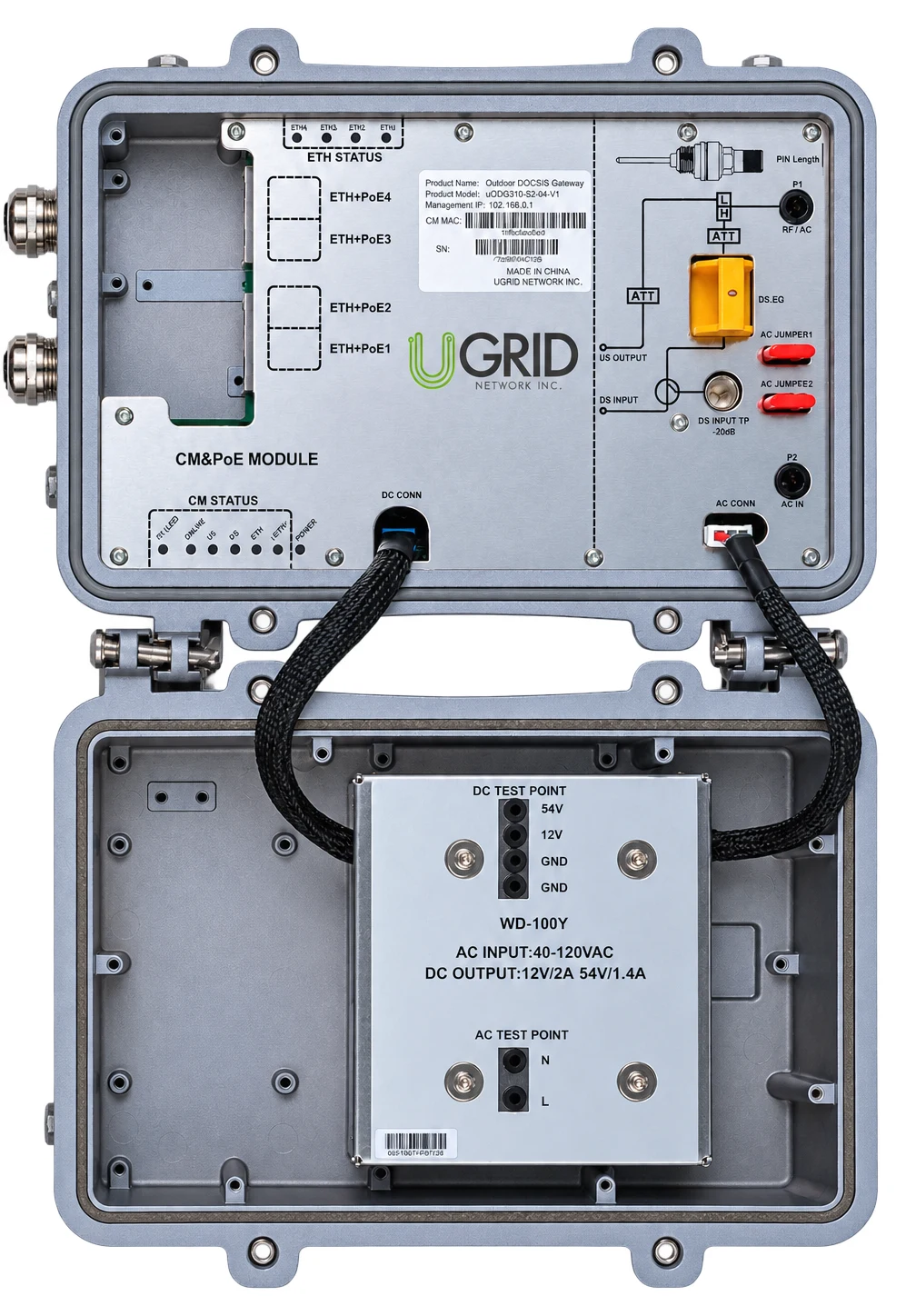
The production uODG310 with its lid open: the CM & PoE module in the chassis, the power module in the lid — with every interface labeled on the unit itself.
 1
2
3
4
5
6
7
8
The uODG310 connects to a CMTS / CCAP headend across the HFC plant, draws its operating power from the coaxial cable, and powers and connects small cells and IP cameras over its four PoE ports.
Deployment scenarios — Small cells · IP video surveillance · HFC cable power · Outdoor PoE · Remote PoE management · Spectrum monitoring
Every value below is from the official uODG310 datasheet (R01).
| General | |
| DOCSIS standard | DOCSIS 3.1 and DOCSIS 3.0 |
|---|---|
| Full-band capture | 1.2 GHz full-band capture front end; integrated real-time spectrum analyzer |
| Frequency range (downstream) | 108/258–1218 MHz (85/108 or 204/258 MHz split) |
| Input impedance | 75 Ω |
| Input return loss | ≥ 8 dB across the frequency range |
| Operating-parameter monitoring | System power consumption, tamper, temperature, RF power level; PoE voltage, current, class and detection |
| Downstream — SC-QAM channels | |
| Number of channels | 32 maximum |
| Modulation | 64-QAM and 256-QAM |
| Level range (one channel) | North America (64-QAM and 256-QAM): −15 to +15 dBmV; EURO (64-QAM): −17 to +13 dBmV; EURO (256-QAM): −13 to +17 dBmV |
| Symbol rate (nominal) | North America: 5.056941 Msym/s (64-QAM), 5.360537 Msym/s (256-QAM); EURO: 6.952 Msym/s |
| Channel bandwidth | North America: 6 MHz; EURO: 8 MHz |
| Throughput | 1600 Mbps (8 MHz, 32-channel bonding) |
| Downstream — OFDM channels | |
| Number of channels | 2 |
| Maximum channel bandwidth | 192 MHz |
| Modulation | QPSK, 16-QAM, 64-QAM, 128-QAM, 256-QAM, 512-QAM, 1024-QAM, 2048-QAM, 4096-QAM |
| Throughput | 3600 Mbps (2 OFDM channels) |
| Upstream | |
| Frequency range (edge to edge) | 5–85/204 MHz (85/108 or 204/258 MHz split) |
| Output impedance | 75 Ω |
| Maximum transmit level | +65 dBmV |
| Output return loss | ≥ 8 dB |
| Upstream — SC-QAM channels | |
| Number of channels | 8 maximum |
| Signal type | TDMA, S-CDMA |
| Modulation | QPSK, 8-QAM, 16-QAM, 32-QAM, 64-QAM, 128-QAM |
| Minimum transmit level | Pmin = +17 dBmV at ≤ 1280 kHz symbol rate; +20 dBmV at 2560 kHz; +23 dBmV at 5120 kHz |
| Throughput | 200 Mbps (8-channel bonding) |
| Upstream — OFDMA channels | |
| Number of channels | 2, independently configurable |
| Maximum channel bandwidth | 96 MHz |
| Minimum occupied bandwidth | 6.4 MHz (25 kHz subcarrier spacing); 10 MHz (50 kHz subcarrier spacing) |
| Subcarrier spacing | 25 kHz, 50 kHz |
| Modulation | BPSK, QPSK, 8-QAM, 16-QAM, 32-QAM, 64-QAM, 128-QAM, 256-QAM, 512-QAM, 1024-QAM, 2048-QAM, 4096-QAM |
| Throughput | 850 Mbps (2 OFDMA channels) |
| Ethernet & PoE | |
| Ethernet | 4× RJ45 Gigabit Ethernet; CAT-5E or better |
| PoE standard | IEEE 802.3af and IEEE 802.3at |
| PoE ports | 1/2/4, configurable; each port configured separately |
| PSE output | 30 W maximum on 2 ports + 15.4 W maximum on 2 ports, configurable; 75 W total |
| Power at PD | 25.5 W maximum on 2 ports + 12.95 W maximum on 2 ports |
| Output voltage / current | +54 V; 600 mA maximum per port |
| PoE mode | Mode A (pins 1, 2, 3, 6) and Mode B (pins 4, 5, 7, 8); remote Mode A/B selection |
| PoE default power | Semi-auto (factory default setting) |
| Power | |
| Cable power (V1) | 60/90 VAC HFC line power; 40–90 VAC cable power, 40–120 VAC wide-range input; 50/60 Hz, sine or quasi-square wave |
| AC mains (V3) | 110–220 VAC |
| Power consumption | 8 W typical, 15 W maximum (excluding PoE load) |
| Surge protection (RF port) | IEEE C62.41-1991 — Cat. A3 ring wave, 6 kV / 200 A; Cat. B3 combination wave, 6 kV / 3 kA |
| Physical & environmental | |
| Dimensions (L × W × H) | 285 × 200 × 120 mm |
| Ingress protection | IP67, dust and water resistant |
| Operating environment | −40 °C to +60 °C; 10%–90% RH, non-condensing |
| Storage environment | −40 °C to +85 °C; 5%–90% RH, non-condensing |
| Monitoring & management | |
| Management | Web, Telnet and console management; SNMP remote monitoring and configuration; FTP remote upgrade; dual image backup and image rollback |
|---|---|
| Monitoring | Real-time spectrum analyzer (1.2 GHz full-band capture); system power consumption, temperature and RF power level; tamper switch monitoring |
| PoE management | Each PoE port configured separately (1/2/4 ports); PoE voltage, current, class and detection monitoring; remote PoE Mode A/B selection; semi-auto default (factory setting) |
Outdoor DOCSIS 3.1 gateway, 1.2 GHz FBC, 4× GE 802.3af/at PoE (75 W total), IP67. Specify the bandwidth split and power supply when ordering — contact UGrid Network Inc. to confirm the full part number.
Both gateways are sealed outdoor units that power field devices over four PoE ports — the difference is the access network they terminate: HFC coax or GPON fiber.
| uODG310 | uOPG800 | |
|---|---|---|
| Access network | HFC coaxial plant (DOCSIS) | GPON fiber (ITU-T G.984.x) |
| Uplink | DOCSIS 3.1/3.0 to a CMTS / CCAP headend | GPON 2.5 / 1.25 Gbps to an OLT |
| User ports | 4× GE with PoE out | 4× GE with PoE out |
| PoE output | 802.3af/at, 75 W total (30 W ×2 + 15.4 W ×2) | 802.3af/at, 75 W total (30 W per port) |
| Power input | HFC cable power (40–120 VAC) or AC mains | HFC cable power (40–120 VAC) or AC mains |
| Environment | IP67, −40 °C to +60 °C, outdoor | IP67, −40 °C to +60 °C, outdoor |
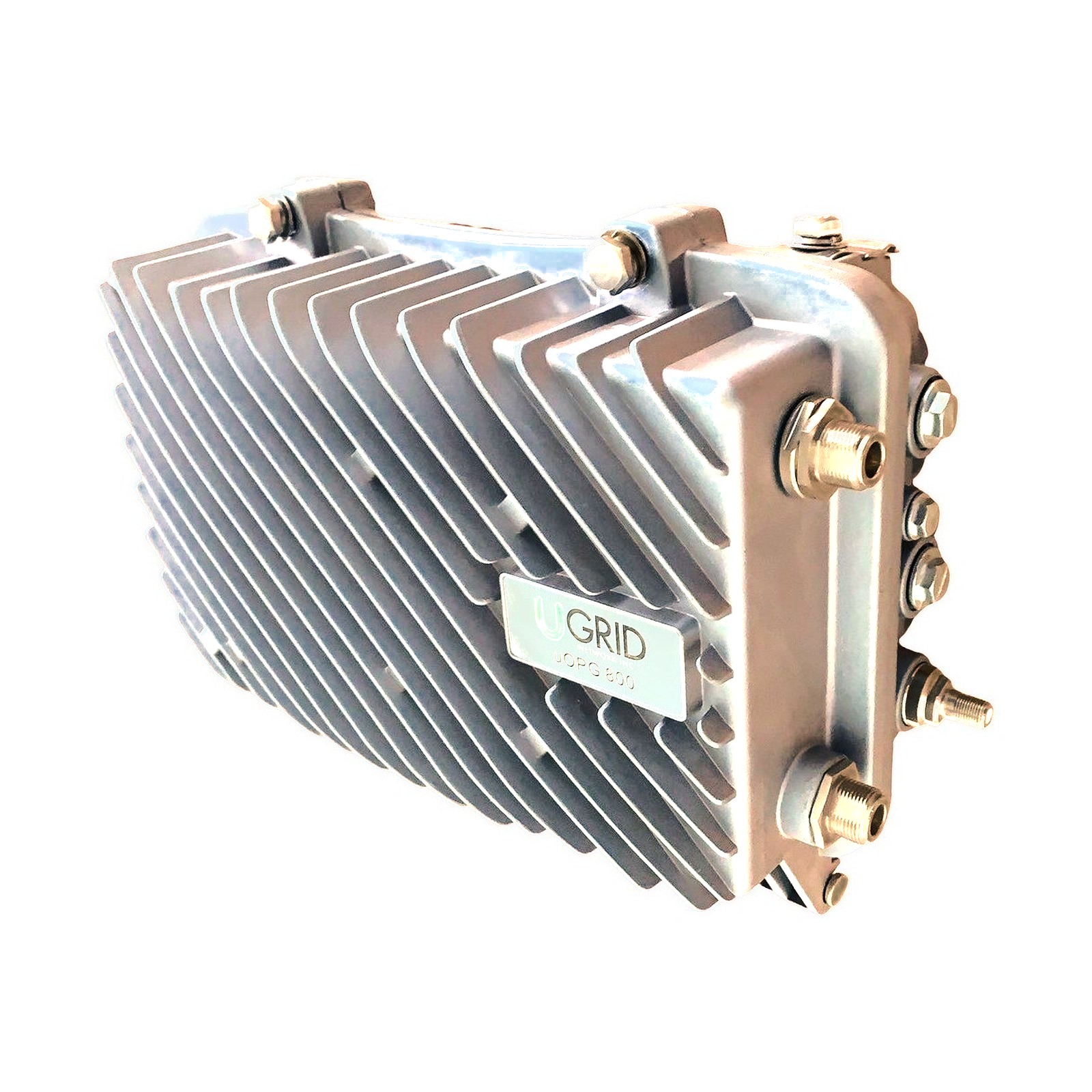
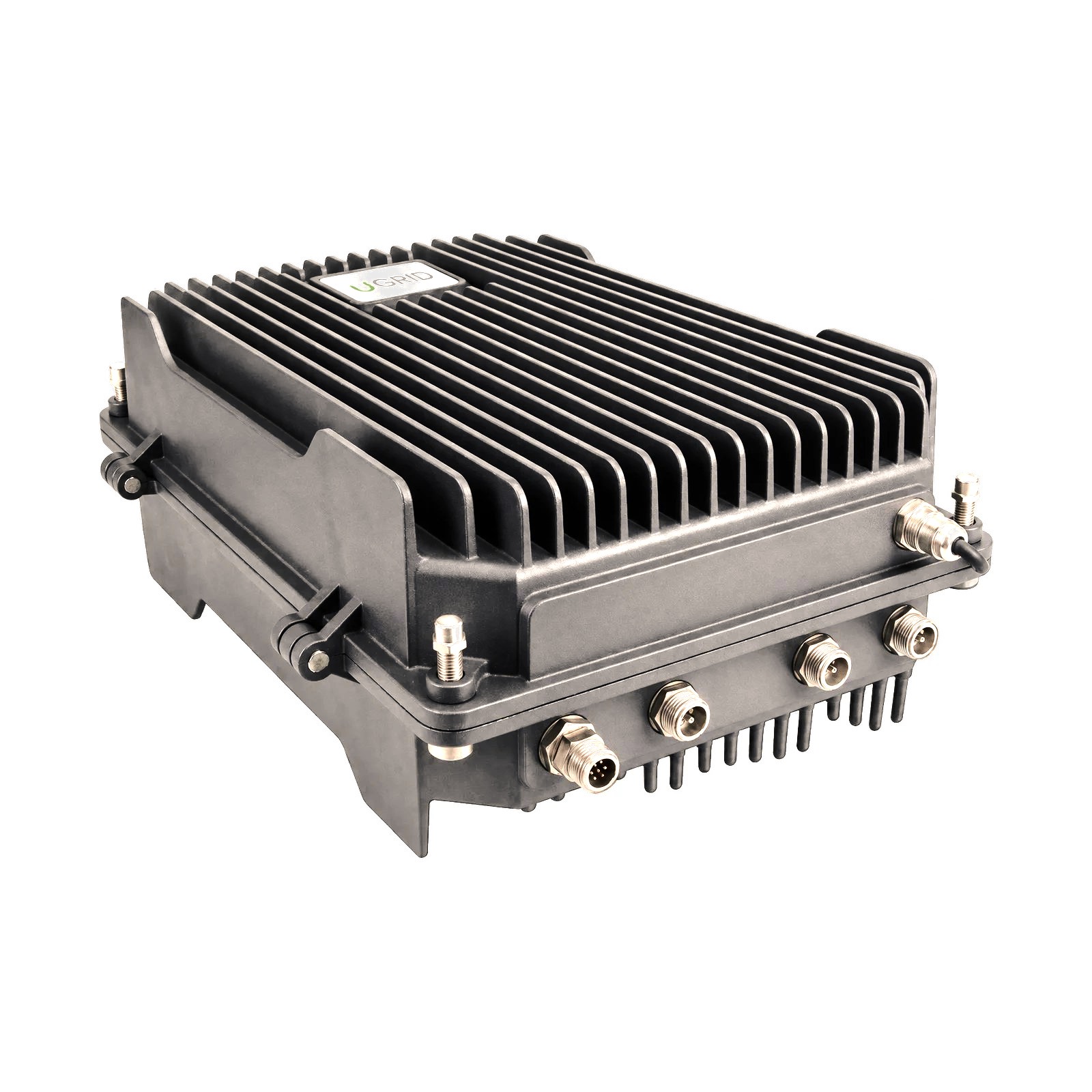
An outdoor DOCSIS gateway is a cable modem gateway in a sealed, temperature-hardened housing for the outside plant. Instead of terminating fiber like an ONT, it connects over the HFC coaxial network to a CMTS / CCAP headend — and the uODG310 also powers field devices such as small cells and IP cameras over its four PoE ports.
It is DOCSIS 3.1 and 3.0 compliant, with 2 OFDM and 32 SC-QAM downstream channels and 2 OFDMA and 8 SC-QAM upstream channels through a 1.2 GHz full-band capture front end. Two diplex splits are offered: 85/108 MHz (S1) or 204/258 MHz (S2).
Two ways: from the HFC coaxial network's 60/90 VAC line power through a 40–120 VAC wide-range input (V1), or from 110–220 VAC AC mains (V3). The gateway itself consumes 8 W typical, 15 W maximum, excluding the PoE load.
Any IEEE 802.3af/at device — small cells, security and traffic cameras, Wi-Fi access points — up to 30 W on two ports and 15.4 W on two ports, 75 W in total, with per-port monitoring of voltage, current, class and detection, and remote PoE Mode A/B selection.
A real-time spectrum analyzer works across the 1.2 GHz full-band capture front end, and the unit monitors its own system power consumption, temperature and RF power level, plus a tamper switch. Management is by Web, Telnet and console, with SNMP remote monitoring and configuration.
Tell us about your deployment — our team typically responds within 2 business days.
Request a Quote